


CO₂ emissions reduction at Nowy Styl - 2025
We invite you to read a summary of Nowy Styl's progress in reducing greenhouse gas emissions and improving energy performance in 2025.
Company policy
Nowy Styl accepts responsibility for reducing the environmental impact of its operations and products. Energy efficiency, renewable energy, circular product development, responsible procurement and transparent CO₂ management are integrated into the sustainability strategy. The CO₂ Performance Ladder provides the management framework for measuring progress, implementing reduction measures and continually improving performance across the participating entities in Poland, Germany and the Netherlands. Nowy Styl was already certified for the Ladder, following Handbook 3.1, level 3.To maintain our responsibility at the highest level, in September 2026 we transfered to the new Handbook 4.0, Step 2. This means that we didn’t only identify our Scope 1 and Scope 2. Also, insights in our Scope 3 were provided. This keeps us ready for a sustainable future.
In the latest EcoVadis assessment, announced in 2026, Nowy Styl received the EcoVadis Platinum Medal for the fifth consecutive year. The company achieved a record score of 89/100, three points higher than the previous score of 86/100, and remained among the top 1% of companies assessed worldwide. The category scores published by Nowy Styl show Ethics at 88/100 (up from 72), Labour & Human Rights at 89/100 (up from 84), Sustainable Procurement at 90/100 (up from 85) and Environment at 88/100. Environmental performance remained one of the company's key strengths.
Among the awards received by Nowy Styl in recent years are: the title of "Ethical Company 2024" together with the "ESG Rising Star" distinction and another title of "Ethical Company 2025" awarded by Puls Biznesu, as well as the Low-Emission Leader award from Forbes magazine.
A new chapter for the CO₂ Performance Ladder
In 2026, Nowy Styl transitioned from Level 3 under Handbook 3.1 to Step 2 under Handbook 4.0. This represents a step forward, as Step 2 under the revised handbook introduces more comprehensive requirements for carbon management, value-chain emissions and climate transition planning.The transition also introduced a revised methodology for calculating and classifying emissions. Consequently, the 2025 footprint is not directly comparable with the 2024 footprint. The differences between the two years may be caused by methodological changes rather than actual changes in energy consumption or carbon performance. However, in 2025, we met our previously established CO₂ reduction target, achieving a reduction of at least 50% compared to 2018 levels. The 2025 footprint is therefore used as the new reference point for future progress reporting.
One specific change concerns business travel, which was previously included in Scope 2 under Handbook 3.1 but is now reported under Scope 3 in accordance with Handbook 4.0.
CO₂ and Energy objectives
Nowy Styl has used the Dutch CO₂ Performance Ladder since 2019. The 2026 certification boundary (over reporting year 2025) covers Nowy Styl sp. z o.o., Nowy Styl Deutschland GmbH and Nowy Styl Nederland B.V.The 2018-2024 target cycle focused on Scope 1 and Scope 2 relative to turnover. From 2025 onward, the Climate Transition and Action Plan uses 2025 as the new baseline and expands the management approach to include Scope 3 value-chain emissions.
The new objectives retain separate monitoring approaches: Scope 1, Scope 2 and Scope 3 are monitored relative to sales turnover. Progress is reviewed annually and measures are adjusted where results or external developments require additional action.
Approved 2028 objectives compared with the 2025 baseline:
- Scope 1: 0.8% reduction, equivalent to 30.20 tonnes CO₂.
- Scope 2: Maintaining the current emissions.
- Scope 3: 6% reduction, equivalent to 4,077.83 tonnes CO₂.
Above mentioned targets are relative to sales turnover.
Approved 2030 objectives compared with the 2025 baseline:
- Scope 1: 1.3% reduction, equivalent to 49.08 tonnes CO₂.
- Scope 2: Maintaining the current emissions.
- Scope 3: 10% reduction, equivalent to 6,796.39 tonnes CO₂.
Approved 2035 objectives compared with the 2025 baseline:
- Scope 1: 6.7% reduction, equivalent to 252.96 tonnes CO₂.
- Scope 2: 100% reduction, equivalent to 157.29 tonnes of CO2.
- Scope 3: 20% reduction, equivalent to 13,592.78 tonnes CO₂.
Energy Objectives
Our objectives to reduce energy are as follows: 0.4% in 2028, 0.6% in 2030 and 3.4% in 2035 compared with 2025. By 2035, Nowy Styl also aims to use renewable energy for its own buildings (excluding heating) and passenger cars. The energy objectives are Scope 1 and Scope 2 combined.Above mentioned targets are relative to sales turnover.
CO₂ emissions in 2025
In 2025, total Scope 1, 2 and 3 emissions totalled 71,896.65 tonnes CO₂ for the companies covered by the CO₂ Performance Ladder certification.Scope 1 and 2 emissions in 2025
Our direct greenhouse gas emissions amounted to 3,775.47 tonnes CO₂ (Scope 1). Indirect emissions from purchased electricity amounted to 157.29 tonnes CO₂ (Scope 2).
Combined Scope 1 and Scope 2 emissions therefore amounted to 3,932.76 tonnes CO₂ in 2025. Business air travel is not included in the 2025 Progress worksheet and has consequently been excluded from the like-for-like comparison in this report. As mentioned earlier, this moved to our Scope 3.
Progress
As 2025 is the first reporting year under Handbook 4.0, no reliable progress or reduction percentage can yet be reported. However, Nowy Styl has now established a complete and transparent picture of its emissions under the new methodology. The 2025 footprint will therefore serve as the new reference point against which future progress and emission reductions will be monitored.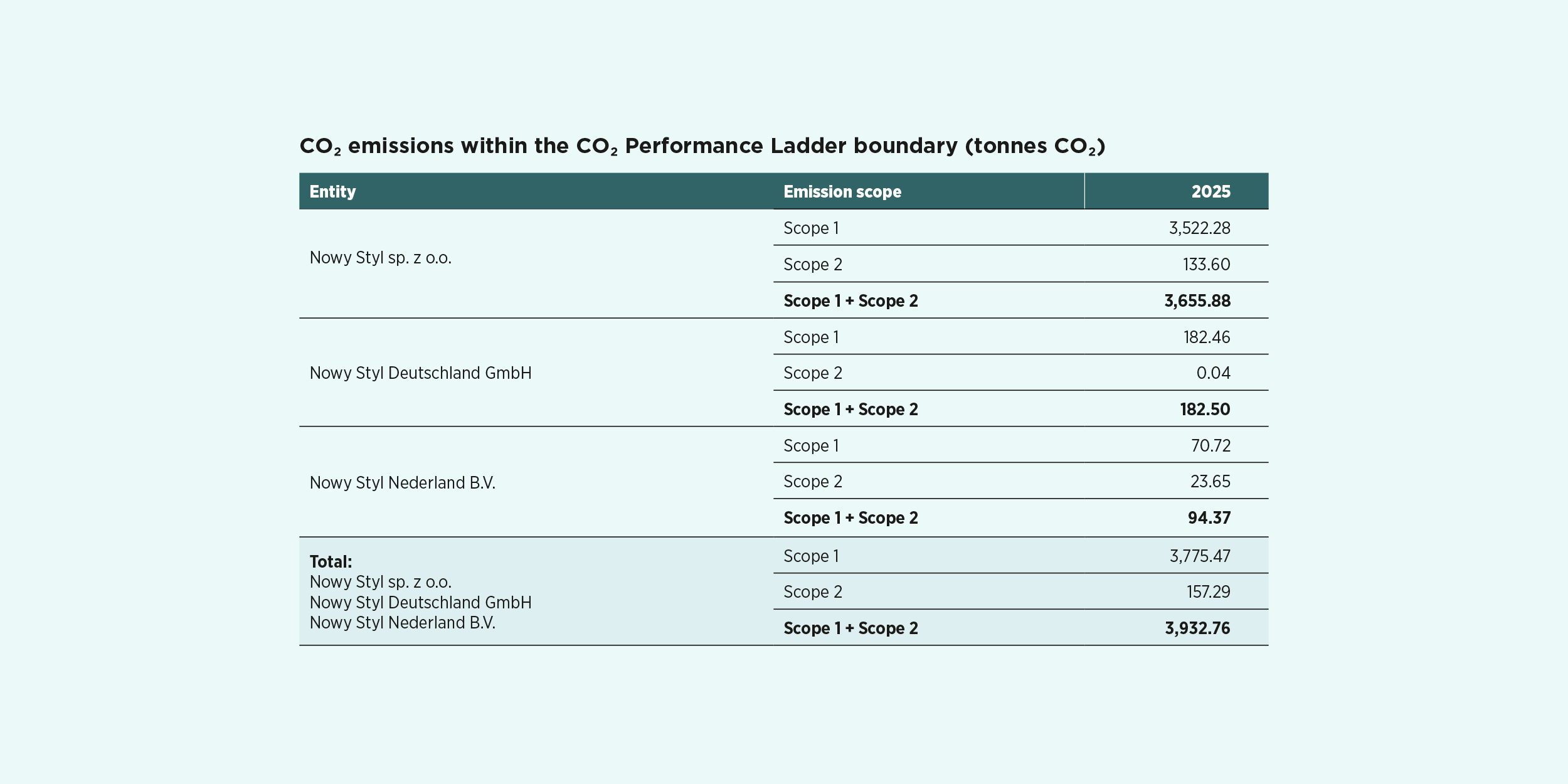
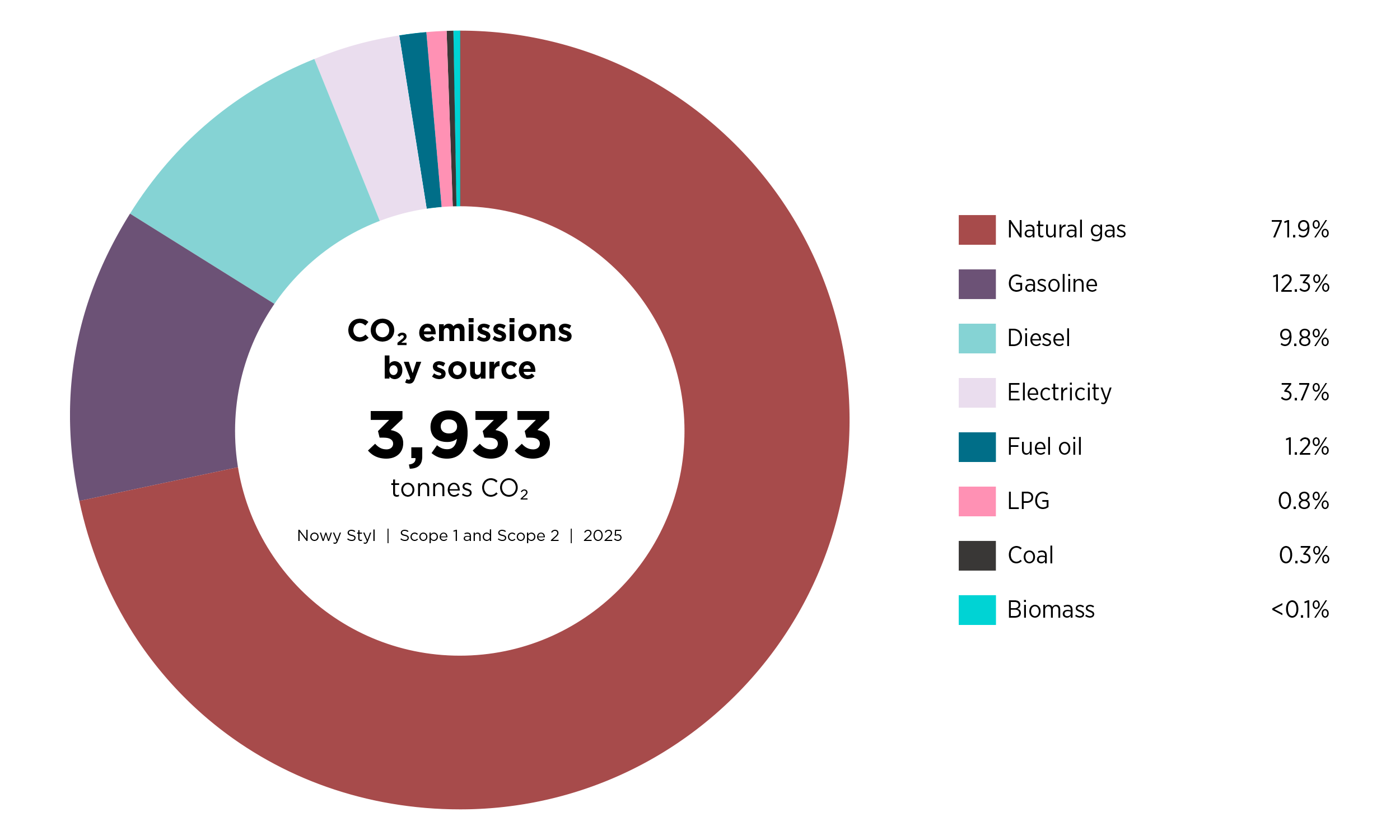
Figure below shows distribution of Nowy Styl’s Scope 1 and Scope 2 emissions by source in 2025, calculated in accordance with CO₂ Performance Ladder Handbook 4.0. Biomass-related biogenic CO₂ emissions are reported separately outside the scope totals.
Scope 3 emissions in 2025
Our first comprehensive Scope 3 inventory for the 2025 baseline amounts to 67,963.89 tonnes CO₂. Upstream emissions account for 64,835.43 tonnes CO₂ (95.39%), while downstream emissions account for 3,128.46 tonnes CO₂ (4.61%). Together with Scope 1 and Scope 2, the measured footprint totals approximately 71,896.65 tonnes CO₂; Scope 3 therefore represents 94.53% of the measured total.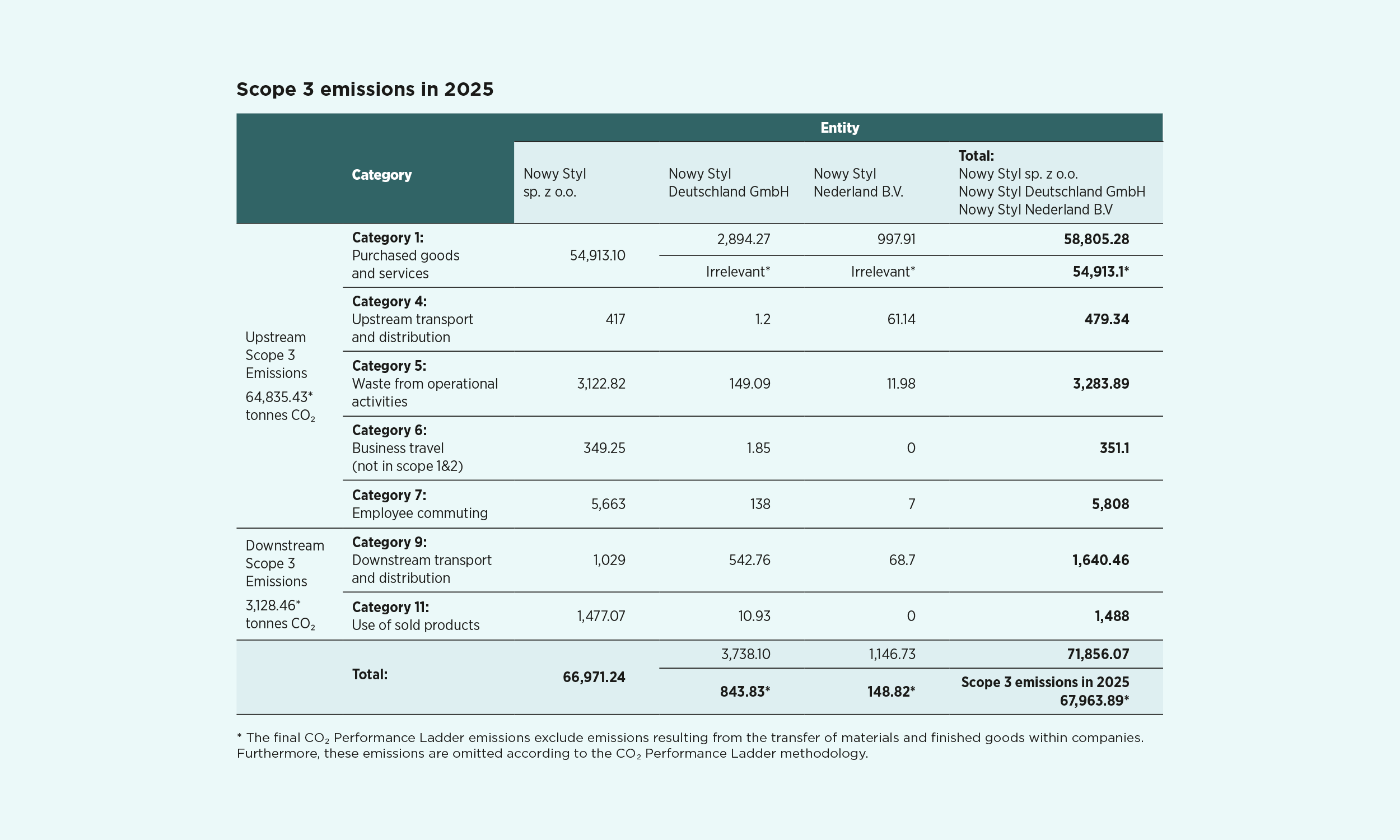
The largest Scope 3 sources are as follow:
The 2025 Scope 3 inventory establishes the baseline for the approved absolute reduction targets: 6% reduction by 2028 (4,077.83 tonnes CO2), 10% by 2030 (6,796.39 tonnes CO₂) and 20% by 2035 (13,592.78 tonnes CO₂). Priority action is therefore directed towards low-carbon and recycled materials, supplier-specific emissions data, commuting, production waste, and lower-emission logistics.
Nowy Styl continued real-time energy monitoring across its main facilities and key production areas. The company started training and preparatory work for an ISO 50001 Energy Management System, modernised compressed-air installations at the Metal Components Plant and the Armchair and Chair Production Plant in Jasło and acquired a sonic camera for detecting leaks in compressed air and technical-gas systems. Renewable electricity significantly reduced Scope 2 emissions. Sustainability was also advanced through the Supplier Sustainability Award 2025 and the 'Together for Sustainability!' webinar, which enabled suppliers to exchange measurable good practices in CO₂ reduction, circularity, social impact and ethical business conduct.
Priorities for the next period
You can read more about this on the CO2 Performance Ladder website. Here you can find our page on The SKAO site.
- Purchased basic iron and steel (17,331.60 tonnes CO₂);
- Purchased metal products (13,065.40 tonnes CO₂);
- Employee commuting (5,808.00 tonnes CO₂);
- Purchased rubber and plastic products (5,352.30 tonnes CO₂);
- Purchased fabrics (4,361.50 tonnes CO₂);
- Operational waste (3,284.00 tonnes).
The 2025 Scope 3 inventory establishes the baseline for the approved absolute reduction targets: 6% reduction by 2028 (4,077.83 tonnes CO2), 10% by 2030 (6,796.39 tonnes CO₂) and 20% by 2035 (13,592.78 tonnes CO₂). Priority action is therefore directed towards low-carbon and recycled materials, supplier-specific emissions data, commuting, production waste, and lower-emission logistics.
What we achieved in 2025
Nowy Styl continued real-time energy monitoring across its main facilities and key production areas. The company started training and preparatory work for an ISO 50001 Energy Management System, modernised compressed-air installations at the Metal Components Plant and the Armchair and Chair Production Plant in Jasło and acquired a sonic camera for detecting leaks in compressed air and technical-gas systems. Renewable electricity significantly reduced Scope 2 emissions. Sustainability was also advanced through the Supplier Sustainability Award 2025 and the 'Together for Sustainability!' webinar, which enabled suppliers to exchange measurable good practices in CO₂ reduction, circularity, social impact and ethical business conduct.Priorities for the next period
- Maintain and substantiate renewable-electricity sourcing for production and offices, supported by verifiable contractual evidence.
- Reduce Scope 1 emissions by improving thermal-energy efficiency and evaluating lower-carbon alternatives for natural gas and fuel oil.
- Continue energy monitoring, compressed-air optimisation, leak detection and preparation for ISO 50001.
- Electrify passenger transport and company fleets where technically and economically feasible, while reducing avoidable business travel.
- Engage suppliers on primary emissions data, EPDs, recycled content, low-carbon steel, circular design, take-back, refurbishment and lower-emission logistics.
- Implement the 2025-2035 Climate Transition and Action Plan and monitor progress annually against the new Scope 1, Scope 2, Scope 3 and energy objectives.
- Continue the Supplier Sustainability Award and structured value-chain dialogue to scale effective environmental and social practices.
You can read more about this on the CO2 Performance Ladder website. Here you can find our page on The SKAO site.